|
Here is a guide which should allow you to date your radio at least to the
nearest five years. Obviously it's no substitute for the facts, which you might
find with proper research, but it's a good way to come to an informed estimate
of the age of your set.
The fundamentals
The basics will give you a good idea of what's going on. Does it look ancient?
It probably is. Does it look Art Deco? It's probably 1930s. Does it have FM? Then
it'll be after 1954. Common sense is a great tool.
What does it look like?
The best guide to a radio's age is the way it looks. If it looks like a piece
of early scientific equipment, with the valves sticking out of the top or the
front of the set, and it is obviously old, it will probably have been made
before about 1927. After this radios were still mainly wood, but the valves
tended to be inside the box, out of harm's way. It was not until about 1932 that
most radios started to look as we expect an old radio to look, with a tuning
dial calibrated in wavelengths and a built-in speaker behind a piece of
decorative cloth.
If the set looks very Art Deco, it's probably in the 1932 to 1936 range,
because after this they tended to look like radios, rather than avant-garde
talking furniture. It is about this age range when the Bakelite cabinets
started to take off. Art Deco styling can be found on both wood and Bakelite
cabinets. In these years, the earlier the radio, the more likely it is to have
a small, quite simple dial, with no station names marked on it.
If the set has Short Wave on it and a big glass dial with lots of technicolour
markings, it's a good bet that it's 1936 or later. There was a fashion for "All Wave"
sets at this time, although many which had a Short Wave range did not pick up
a great deal of stations on Short Wave. Any set which was even vaguely up with
the latest fashion had to have as many colours of print on the dial as possible,
and also as many station names as the manufacturers could squash on. Most of these
stations would never be receivable on that set in the UK, but that didn't put
them off.
By 1938 the level of complexity built into even quite average radios had increased
and most sets had some sort of "feature" to sell them. Most featured large speakers
and quite powerful outputs, and almost all had very colourful backlit dials. Quite
a good proportion had some kind of pre-set tuning, usually using press-buttons,
though some had contraptions almost like telephone dials where the station was dialled
up. The most adventurous had motor tuning, where the push-button activated a
motor, which tuned the set.
The war made a big difference to radio design, with the press-button tuning and
other complexities vanishing almost overnight. The 1940 sets were much more
austere, and most had very few, if any, flashy features. At the end of the war,
companies had to return to the domestic set market in a bit of a hurry, and
many put out models very closely related to the products they were producing
in 1940 when production of domestic sets ceased. To sort out the pre-war from
the post-war here can be hard. Check the dial. (See later.)
Most of what turns up these days tends to be post-war. The 1940s things look
very much like the 1950s things, so the best way to sort one from the other is
on the basis of the valves inside. (See later.)
In 1954, domestic FM broadcasting became a reality and the first of the FM sets
were released. Obviously the cheaper sets did not have FM coverage even many
years after this date, so a set with FM will be after 1954 and probably somewhere
near the top of that company's range.
The late 1950s brought a craze for piano-key wavechange switches, and for a
while, everybody had to have them. This lasted in some companies until the mid
sixties, but in general the craze died down by about 1960.
After this you are in the transition period between valves and transistors, and
you get some funny things happening. About 1965 you get radios which look like
valve sets, but contain a transistor chassis and usually a very large battery.
These soon died out, though, as TV at last pushed the radio out of the living
room and made it wander around the house as a portable.
What does it say on the dial?
The tuning dials usually have station names printed on them, and by checking
the name and the position on the dial, you can gain a good idea of when the
radio was designed.
The Long Wave National transmitter changed from Daventry (4XX) to Droitwich in
1934. So if it says Droitwich on the dial, it's after 1934.
The regional network closed down for the war, so the late 1939 and early 1940s
offerings tend to be labelled with "BBC" or something equally non-committal in
a lot of places on the dial.
The Forces programme present on the dial tells you that it's a wartime set.
The Home service was named by 1946, so a radio with Home on the dial will be
post war. The Light and the Third followed later. The regional scheme was re-
introduced very soon after the war, and most of the post-war sets have some
indication of a regional network on the dial. So even if it doesn't call it
the Home service, it might call it Northern, Midland, etc.
The 1940s and 1950s sets don't reveal much by their dial markings, because there
was a period of stability in the allocation of various frequencies allocated to
various countries due to the implementation of the Copenhagen Agreement, where
all this was decided, just after the war. Lots of dials at this time have the
magic word "Copenhagen" in the corner, often out of sight until the dial is removed
from the radio. That refers to the frequency plan, not where the dial was made
or who by.
The Valves
The valves can tell you a lot about the age of the set.
The very early valve sets use R valves, which are bright-emitters. These light up like
light-bulbs when in use, and nice early examples will have spherical glass
bottles and maybe a little glass pip on the top where the seal was made when the
valve was manufactured. Later offerings tend to be more pear-shape and lack
the top pip. However, they will still be pretty ancient, and may well have a
number (such as R5V) on them somewhere. These will date the set roughly as
1927 or before.
After the bright emitters came the dull emitters. These were built quite like
the later versions of the R valve, but the filament had a more efficient coating
on it, and hence could be run at a lower temperature, so these only glow dull
red when in use. These were used in some sets as replacements for R valves, so
if your set has little inspection grilles for each valve inside and a rheostat
for each filament, it's quite possible that it originally had R valves.
Sets using only simple dull-emitter triodes will most likely date from 1930
or before. After this date, more efficient valves became available.
The next development was the pentode valve. This came in two forms. There was
the HF type for the radio end of the set, and then there was the audio type
for loudspeaker-driving duty. The HF pentodes made possible much greater gain
at high frequencies, and hence allowed more stations to be received with fewer
valves, and less adjustments and tuning controls to contend with.
The audio pentodes also allowed greater gain, but at this end of the set, the
greater gain meant that the chances of a station being strong enough to drive
the loudspeaker were improved.
After this, the valve makers put some effort into making valves for mains-powered
sets, which by 1932 were becoming a reality. The major difference is the addition
of a cathode, so that the heater only heats the cathode, and the cathode emits
the electrons and works the rest of the valve. This meant that AC could be used
to heat the valves without causing hum problems. The mains valves were used until
the war with fairly minor developments. One of the major changes was the need for
more pins on the valve base, and for the first time, valves with seven pins were
made. The numbering systems were reasonably logical, though every manufacturer had
their own.
An interesting development was the 1933 Catkin valve, by Osram. These had the
same characteristics as some of the ordinary mains types, but due to advances
in methods for joining metal to glass, these could be made without a conventional
bottle. This meant that the anode formed the outer surface of the valve proper,
and in order to provide built-in screening, the diamond-punched metal can was
put around the outside. These must have been expensive to make because they did
not stay in production long and are comparatively scarce now.
About 1936, the continental valve makers were making more complex valves, and
putting them on their new side-contact base. This was never a popular range of
valves in British sets, but Mullard did market the range in the UK, due to its
links with Philips in Holland. Most UK radio manufacturers ignored the new valves
and carried on just as they had been.
About 1937, the American Octal base made its entry into the UK domestic set
market. This base had eight pins, which allowed more complex valves, and even
two simple electrode structures in the same valve. HMV, Marconi and GEC were
among the first to use the Octal valves. They developed their own variations on
the standard American valves. With the Octal valve, the standard heater voltage
changed from the previously normal 4V to 6.3V
Not to be left out, other British valve makers introduced Octals as well. Mazda
introduced their own variation on the theme in 1938, with a similar base which did not
fit in the American Octal socket, and had the old fashioned 4V heaters. These
Mazda octals did catch on with the companies which used Mazda valves, such
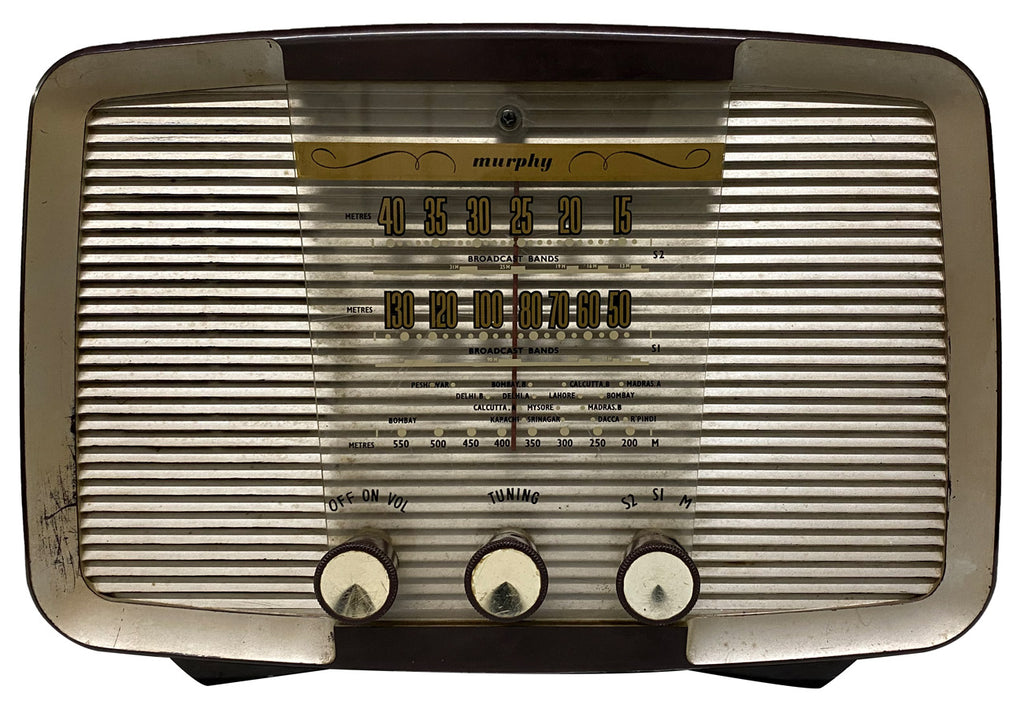
as Murphy, and they made some fine sets with them, before and after the war.
The Mazda octal valves are very reliable and even today have a good reputation.
Mullard launched their Octal range in 1939. They used the American Octal
base, but used the electrode structures from the Euro-trash side-contact
range which had been a poor seller before. The resulting range of valves
were accepted almost universally by radio manufacturers, and became very popular
in some of the last pre-war radios, and many of the 1940s sets made after the
war.
During the war, a lot of work was done on developing valves to give higher gain
at higher frequencies. Probably the most notable was the EF50, which was a
basic tool of the early Radar installations, and it is cerain that this valve
helped to shape the war. They were used after the war in some televisions
released about 1946, but most were made for the military and used in military
applications. In the 1950s, the government sold off huge numbers of unused
surplus stock EF50s, and almost every radio enthusiast making his own gear
used one for something.
After the war, there was a move towards smaller radios. This forced smaller
valves. One of the first moves in this direction was the American "Bantam" valve,
otherwise known as "GT" shape, which was a standard American Octal valve, with
a narrow, straight-sided, reduced-height bottle, which took up less room. These
were in use in America well before the war, because Midget radios were part of
the American scene from the mid thirties onwards.
However, wartime advances in the manufacture of valves made possible new types
of valve using new techniques. It was no longer necessary to have a valve which
consisted of a bottle stuck onto a base where the pins lived. It was now possible
to make a flat-bottomed bottle, and set the pins directly into the glass. This
made the base redundant and a lot of space could be saved.
One of the first of the smaller bases was the B7G, which seems to have been
imported from America, and was pioneered in this country by Brimar and Marconi and Osram.
These little valves were dramatically smaller than anything which had gone
before and made possible some very compact sets. However, their reliability has
proved to be only moderate, probably due to the higher temperatures reached by
the smaller, more compact structures inside.
A later addition was the B8A base, which was introduced in 1947 with a metal
band around the bottom. This base was backed heavily by Mullard, and Mazda again
made their own version, this having a metal pressing with the band around the
bottom and a locating spiggot in the middle, between the pins. However, unlike
the situation with Octals, most sockets would accept either variant. These valves
were used in sets from about 1949, but were still being fitted into new designs
as late as 1953 or 1954. After this date, they were still widely used, but usually only for
some of the valves, with newer valves on different bases used for the other jobs.
In 1953 the base was revised and made entirely of glass. Most examples are all-glass.
In 1951, the Noval base was introduced. This had nine pins, and was pretty well
the last of the valve bases introduced. Valves on this base started to be used
as early as 1951, but it is not until about 1954 that sets using only Noval valves
turn up. By 1956 the Noval was used almost universally, but it is possible to
date a "late 1950s Noval set" a little closer by looking at the types used.
If the set has FM, the give-away sign is in the FM head unit. A pair of pentodes (EF80)
will put the set in the early FM era, say 1954/55. A double triode (ECC85) will put it after
this.
The IF amplifier valve will give some clues too. The early Novals used
EF85, but after about 1957, the EF89 replaces it and gives more gain. A set using EBF89
as an IF amplifier is usually after 1959.
Strange output valves such as ECL86, ELL80 and ECLL80 point to a radio made
in the 1960s, usually in Europe. Most of these sets also use a metal rectifier
in place of a rectifier valve, and have at least some Germanium diodes
as detectors, usually for FM, normally using an EBF89 as IF amplifier and AM
detector.
|